· 5 min read
Threading vs Waxing for Face: Pros & Cons by Skin Type
Threading and facial waxing both remove hair beautifully — but one will suit your skin far better than the other. Here's how to choose based on your skin type, sensitivity and lifestyle in Lahore.
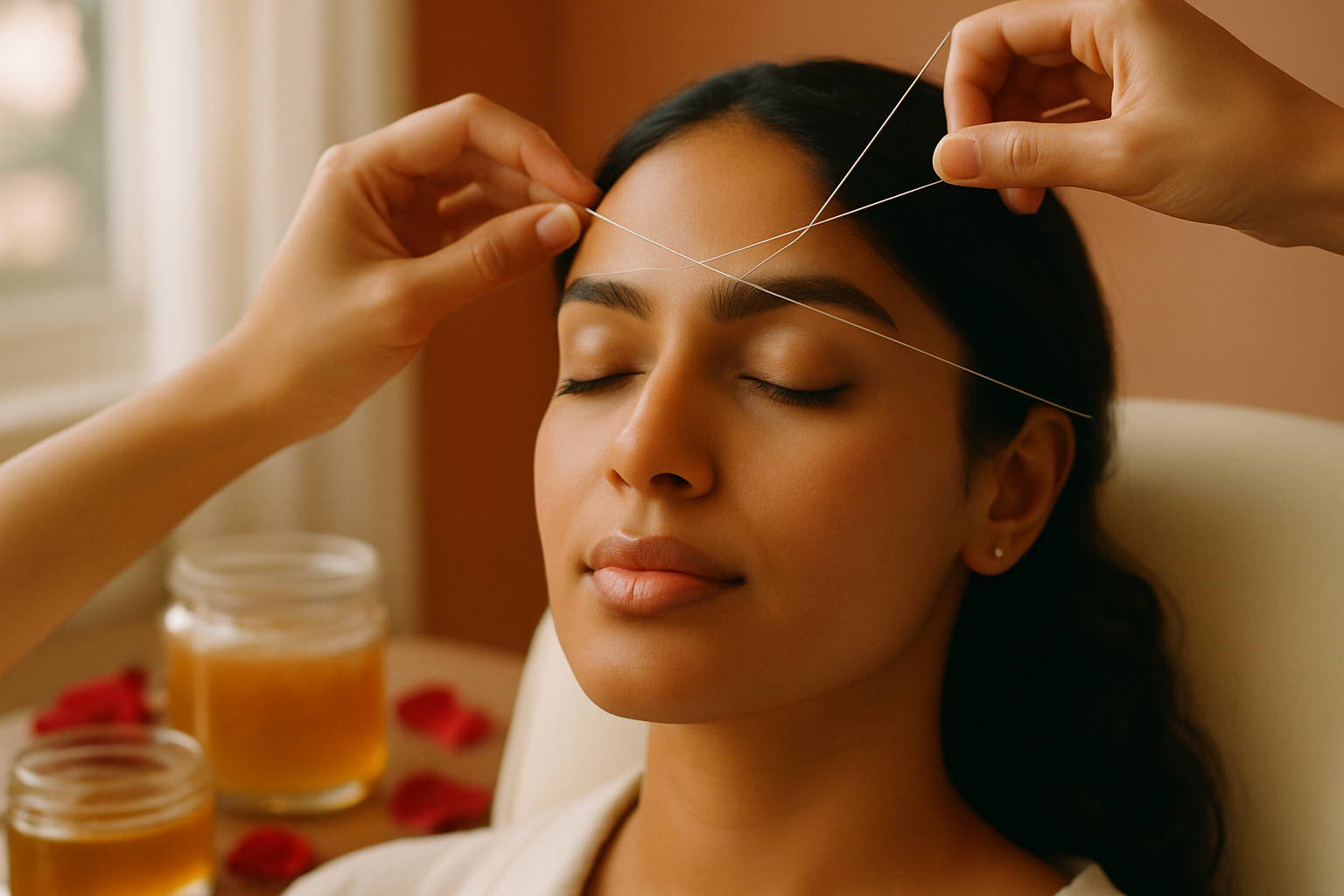
Facial hair is one of those things most women in Lahore quietly manage every few weeks — and the method you pick matters more than you'd think. The wrong choice can leave you with breakouts along the jaw, red bumps above the lip, or peach fuzz that grows back thicker-feeling than before. The right one leaves your skin looking cleaner, brighter and makeup-ready. Threading and waxing are the two most requested facial hair removal methods at our DHA Phase 3 salon, and clients often ask which is actually better. The honest answer: it depends entirely on your skin type, the area being treated, and how your skin behaves post-treatment. Here's the real breakdown.
How Threading and Waxing Actually Work
Before we compare them, it helps to understand what each method is doing to your skin.
Threading uses a doubled, twisted cotton thread that traps individual hairs and lifts them out from the follicle. It's a precision technique — the therapist controls exactly which hairs come out, one row at a time. There's no product on the skin, no heat, and no chemicals.
Waxing applies a warm (or room-temperature, in the case of sugar) substance that adheres to hair, and is then pulled off in the opposite direction of growth. It removes hair in a single sweep, along with a fine layer of dead skin cells and vellus (peach fuzz) hair.
That difference — targeted lift vs. broad pull — is why the two feel and heal so differently.
Pros and Cons at a Glance
Threading — the good
- Extremely precise, especially for brow shaping and small areas like the upper lip and chin
- No product contact, so nothing to react to — ideal for sensitive or reactive skin
- Safe over active acne in most cases, because the surrounding skin isn't pulled aggressively
- No risk of burns from hot wax
- Works on very short hair that wax can't grip
Threading — the trade-offs
- Can feel sharper on first-timers, particularly on the upper lip
- Slight redness for 15–30 minutes is normal
- Not practical for larger areas like full cheeks or sideburns
- Skill of the therapist matters enormously — poor threading causes broken hairs and uneven brows
Waxing — the good
- Faster for larger areas (full face, cheeks, sideburns, jawline)
- Removes peach fuzz along with terminal hairs, giving that instantly glowy, makeup-ready finish
- Regrowth often feels softer because hairs come back with tapered ends, not blunt-cut
- Gentler modern formulas (organic sugar, fruit wax) are far kinder than the traditional hot wax of a decade ago
Waxing — the trade-offs
- Risk of lifting delicate facial skin if done incorrectly, especially around the eyes and lips
- Not safe over active acne, cold sores, retinoid use, or recently exfoliated skin
- Can trigger post-inflammatory pigmentation in deeper skin tones if applied too hot
- Requires 2–3 mm of growth to work properly
Which Method Suits Your Skin Type
Sensitive or reactive skin
Go with threading. If your skin flushes easily, reacts to new products, or you have rosacea-adjacent redness, threading with thread is the safest bet. There's no adhesive, no heat, no chance of a wax residue reaction. Stick to brows, upper lip and chin — the areas threading does best.
Oily and acne-prone skin
This is where it gets nuanced. If you have active breakouts, thread — never wax over a pimple, it can spread bacteria and tear the skin. If your skin is oily but currently clear, a gentle organic sugar wax actually works beautifully because sugar paste only adheres to hair and dead skin, not living tissue, so the risk of irritation is lower than with traditional wax.
Dry or mature skin
Waxing can be risky here because dry skin is more prone to lifting and micro-tears. If you love the peach-fuzz-free finish that only wax gives, opt for fruit wax, which is lower-temperature and more conditioning. Otherwise, threading paired with a good hydrating facial is the safer long-term routine.
Combination skin (most Lahore clients)
Mix and match. Thread the brows and upper lip for precision, and wax the cheeks and jawline every 4–6 weeks if you want that smooth, luminous finish under foundation. This is the most requested combination at Rabbiz.
Skin on retinoids, acids or recent facials
Avoid waxing for at least 5–7 days on either side of active treatment. Threading is generally safe, but tell your therapist what you're using so she can be extra gentle.
Area-by-Area Recommendations
- Eyebrows — Threading, almost always. The precision is unmatched, and brow shape defines the whole face.
- Upper lip — Threading for sensitive skin, sugar wax for smoother finish under lipstick
- Chin — Threading, especially for stubborn coarse hairs that need to be plucked one by one
- Cheeks / full face — Waxing, ideally sugar or fruit wax, for that fuzz-free glow
- Sideburns — Waxing, done carefully; threading takes too long here
- Forehead / between brows — Threading
Aftercare That Actually Matters
Whichever method you choose, the first 12 hours decide whether you glow or break out.
- No makeup for at least 4–6 hours after either treatment. Freshly opened follicles are an invitation for clogging.
- Skip actives that evening — no retinol, no AHAs, no vitamin C serums.
- Cool compress if there's redness. A clean cotton pad soaked in chilled rose water works beautifully.
- No sun for 24 hours — Lahore's UV is brutal, and freshly waxed skin can pigment quickly.
- No hot showers, steam or gym for the rest of the day, especially after waxing.
- Follow up 24 hours later with a gentle exfoliation to prevent ingrowns, then a lightweight moisturiser.
If you're prone to bumps after facial hair removal, book a calming facial the following week — it soothes the skin barrier and evens out tone.
How Often Should You Go?
Most women need touch-ups every 3–4 weeks. Threading regrowth appears slightly faster because hairs are removed individually as they emerge, while waxing tends to give you a full 4-week clean window because everything in that growth cycle comes out together. Consistency matters — the more regularly you commit to one method, the finer and more predictable regrowth becomes.
Whichever you pick, the therapist matters more than the method. A skilled hand, hygienic tools, and skin-appropriate products will always beat a fancy technique done carelessly. When in doubt, book a consultation and let your skin decide.