· 5 min read
Keratin Treatment Myths Debunked for South Asian Hair
Frizzy, thick, humidity-battered South Asian hair reacts differently to keratin than the glossy 'before and after' videos suggest. Here's what actually happens — and what to ignore.
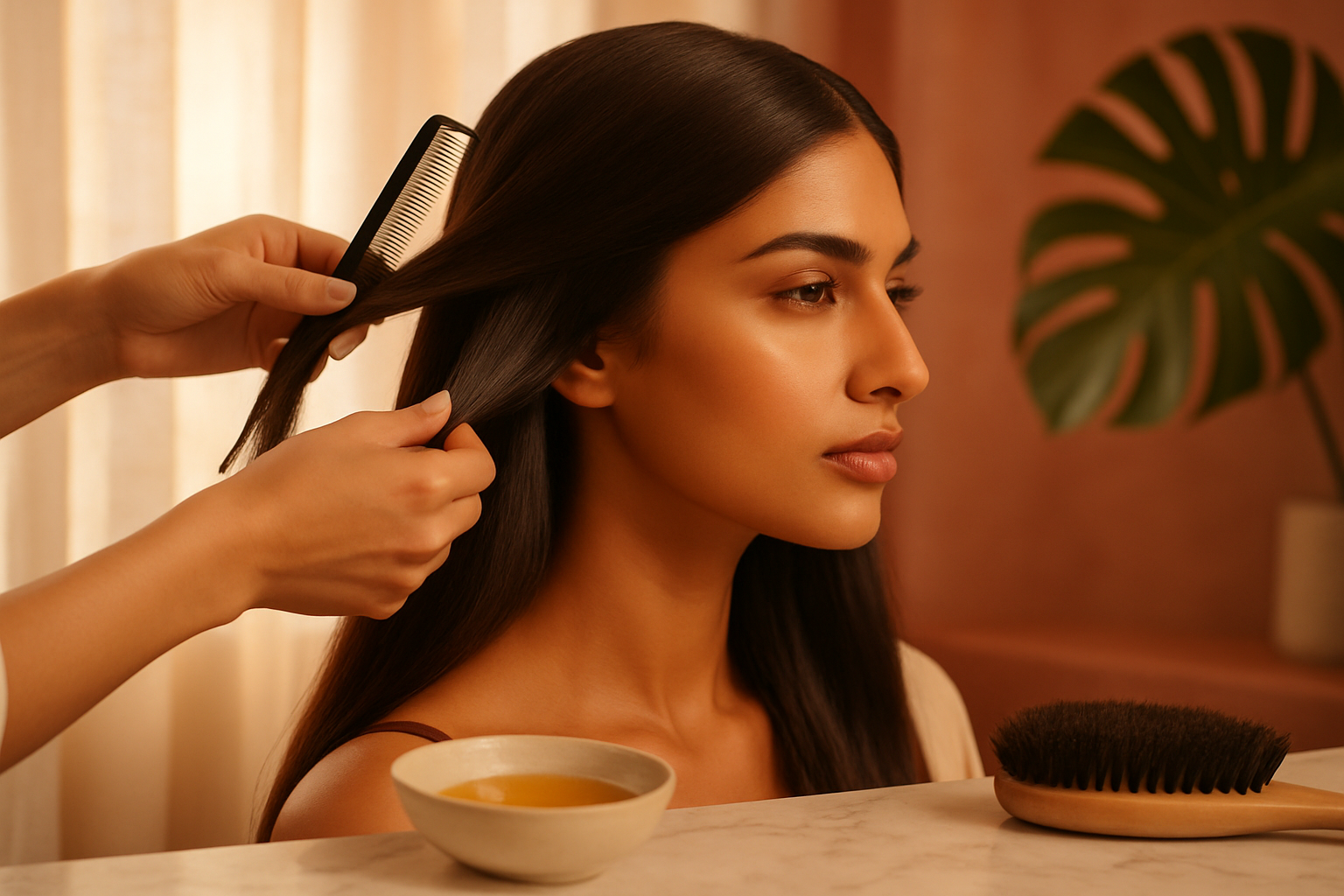
If you've scrolled through Instagram in Lahore lately, you've probably seen dozens of before-and-after keratin reels — pin-straight, mirror-shiny hair emerging from what was, minutes earlier, a monsoon-frizzed mane. It looks magical. It also looks identical across every account, which should tell you something: most of what circulates about keratin online is marketing, not science. And South Asian hair — thick, textured, often colour-treated, frequently oiled — behaves very differently under a keratin service than the fine European hair these videos usually feature. After years of doing smoothing treatments on clients across DHA and greater Lahore, here's what I wish more women knew before booking one.
Myth 1: Keratin Will Permanently Straighten Your Hair
This is the single most common misconception, and it's the one that leads to the most disappointment. A keratin treatment is a smoothing treatment, not a straightening one. It coats the hair shaft with a keratin-rich formula that's then sealed in with heat, reducing frizz and cutting blow-dry time in half. But your curl pattern is genetic — it will loosen and soften, not disappear.
What you should expect on South Asian hair:
- Waves relax into a gentle S-shape
- Coarse texture feels noticeably silkier
- Blow-drying becomes faster and lasts longer
- Humidity frizz drops dramatically (this is the real win in Lahore's climate)
If you want stick-straight hair permanently, you're thinking of a rebonding or Japanese straightening service — a completely different chemical process with far more commitment. During a consultation for our hair treatments, we usually show clients photos of realistic results on hair like theirs, not curated internet transformations.
Myth 2: All Keratin Treatments Are Full of Formaldehyde
The formaldehyde panic is outdated. Yes, early-generation Brazilian blowouts relied on high concentrations of formaldehyde or its derivatives, and yes, those were genuinely harmful — especially to the stylists inhaling fumes all day. But the industry has moved on.
Modern professional keratin systems fall into three broad categories:
- Formaldehyde-based — strongest smoothing, longest-lasting, but should only be done in well-ventilated salons and avoided during pregnancy.
- Glyoxylic acid or amino-acid based — the current gold standard for most clients. Gentler, no harsh fumes, results last 3–4 months.
- Botanical or 'express' keratin — very mild, coats rather than restructures, lasts 4–8 weeks. Great for a first-timer.
Ask your salon which system they use and read the ingredient list. A reputable stylist will happily show you the bottle. If they get evasive, walk out.
Myth 3: Keratin Damages Your Hair
A correctly done keratin treatment does not damage healthy hair — in fact, it can protect it from further environmental stress. The damage narrative usually stems from one of three real problems: the wrong formula for your hair type, an overheated flat iron (some stylists crank it to 230°C on fine hair, which is reckless), or pre-existing damage that the treatment exposed rather than caused.
Where South Asian women often get caught out:
- Getting keratin done on top of heavy henna buildup — the formula can't penetrate evenly
- Layering keratin over a fresh global colour without waiting the recommended 10–14 days
- Booking keratin when the hair is already fried from previous bleaching
A good stylist will do a strand test, especially if your hair is coloured, chemically treated, or has years of oil-massage buildup. Our hair team routinely refuses to keratin hair that isn't ready — because a rushed service is what actually causes damage.
Myth 4: You Can't Wash, Tie or Touch Your Hair for Three Days
This rule used to be gospel because older formaldehyde formulas needed 72 hours to fully cure. Modern glyoxylic and amino-acid systems typically only require 8–24 hours of 'settling time,' and some are technically washable the same day.
That said, here's what genuinely helps the treatment last on South Asian hair:
- Wait at least 48 hours before the first wash, if possible
- Skip tight hair ties, clips and tucking behind the ears for the first day — kinks can set in
- Sleep on a silk or satin pillowcase from night one
- Use a sulphate-free, sodium-chloride-free shampoo — this matters more than the wait time
The pillowcase and shampoo choice will extend your results by weeks. The 72-hour lockdown, less so.
Myth 5: One Treatment Fits All Hair Types
South Asian hair is not monolithic. A Punjabi woman with thick, coarse, wavy hair needs a completely different formula strength and processing time than someone with fine, straight-ish hair or the tighter 3B-3C curls many of our clients have. A one-size-fits-all keratin — the kind offered at rock-bottom prices around Lahore — is exactly why so many women end up with limp, greasy roots, uneven smoothing, or reversion within three weeks.
Things a proper consultation should cover before mixing anything:
- Porosity (does your hair drink up oil or repel it?)
- Current colour and chemical history
- Density and curl pattern
- Scalp condition
- Lifestyle — gym, swimming, how often you wash
When Keratin Is Genuinely Worth It
- You spend 40+ minutes blow-drying and still fight frizz by afternoon
- You live in humid neighbourhoods (which, in Lahore summer, is all of them)
- Your hair is healthy but unmanageable
- You want to reduce heat-styling long-term, not increase it
When to Skip It
- Your hair is severely bleached or breaking
- You love your natural curl and just want definition (get a curl-cut and hydration treatment instead)
- You're pregnant or breastfeeding — even with gentler formulas, err on the side of caution
Myth 6: Keratin Is a One-Time Investment
It's an ongoing commitment, not a purchase. Depending on the system, you'll want a touch-up every 3–5 months to maintain the smoothness. In between, aftercare determines everything — the right shampoo, occasional deep-conditioning masks, and avoiding the temptation to bleach or henna over your treated hair.
Many of our regulars pair their keratin with a monthly hair spa or protein-balancing session at our hair treatments studio to keep the shaft strong between full treatments. Think of it like skincare: the facial isn't enough on its own, and neither is the keratin.
The Honest Bottom Line
Keratin is one of the best things to happen to South Asian hair in humid cities — if it's done properly, on hair that's ready for it, with a formula matched to your texture and lifestyle. It's not magic, it's not permanent, and it's not risk-free at the wrong salon. Book a proper consultation, ask the questions, and don't let a reel decide for you.